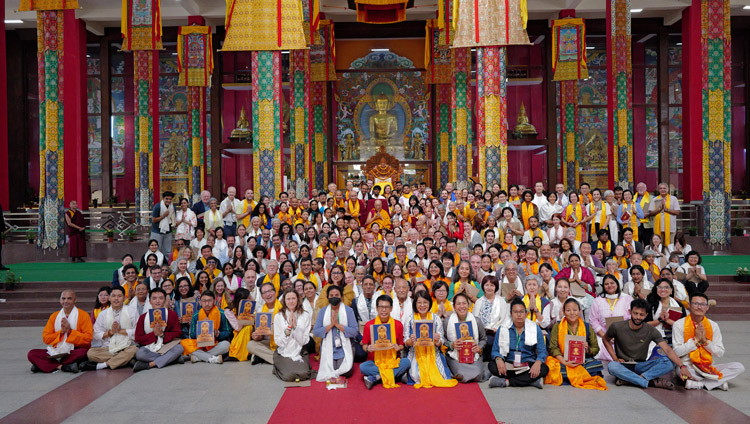
Drepung Gomang, Mundgod, Karnataka, India - Yesterday, 237 students of Geshé Dorjee Damdul, Director, Tibet House, New Delhi, attended an audience with His Holiness the Dalai Lama. Geshé-la introduced the students, more than one hundred of whom were Indians while others came from many different countries around the world. He explained that that they were in Mundgod to take part in a 10-day Retreat, beginning on 8th January 2026, focussing on Special Insight that had been organised by Tibet House, New Delhi at the Science and Meditation Centre of Drepung Loseling Monastery.
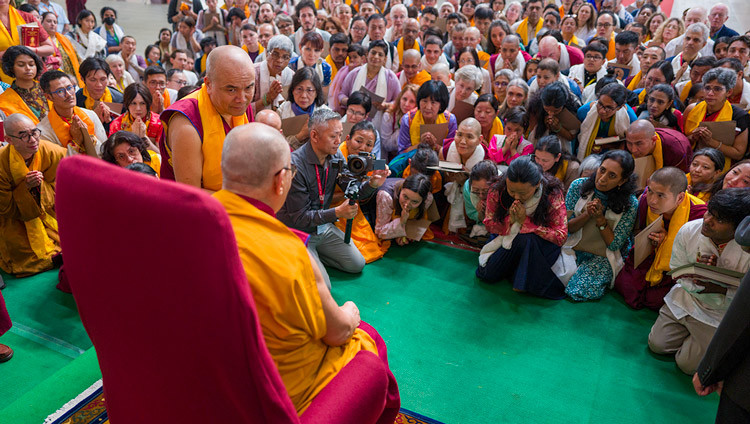
After meeting His Holiness, the students took part in a brief ritual to generate the aspiring awakening mind of bodhichitta as expressed in the following verse:
I go for refuge to the Three Jewels
I confess each and every misdeed
I rejoice in the wholesome actions of all beings
I take to heart the enlightenment of Buddhas.
I seek refuge in the Buddha, Dharma and Supreme Assembly
Until I reach enlightenment.
In order to fulfil the aims of myself and others
I shall develop the awakening mind of enlightenment.
Having developed the aspiration for highest enlightenment,
I invite all sentient beings as my guests,
And will enact the delightful practices of supreme enlightenment;
May I become a Buddha to benefit all sentient beings.
Subsequently they chanted the following verse in praise of Buddha Shakyamuni as well as his mantra.
Skilfully and out of compassion you took birth in the Shakya family,
You crushed the evil forces and became invincible,
You possessed a body like a majestic golden mountain
I bow to you, O Shakyasinha, the King of the Shakyas.
Om Muni Muni Maha Muna Ye Svaha
His Holiness then addressed the gathering.
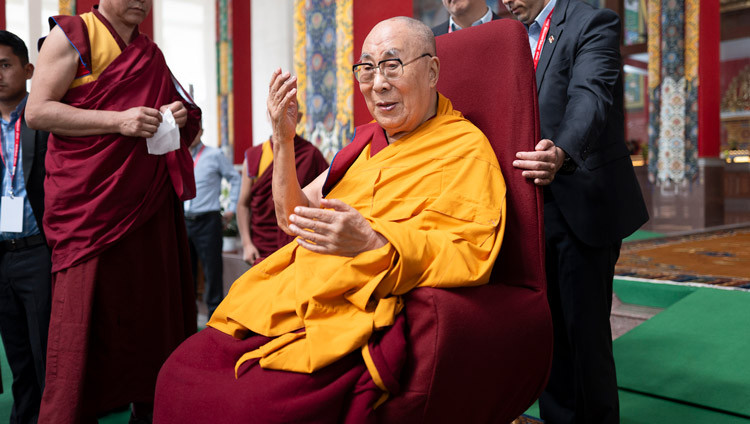
“Buddhism spread throughout the length and breadth of Tibet, the Land of Snows. I was born in Dhomey (Amdo), but even when I was a child I had single-pointed faith in the Buddha and a fervent wish to see the Jowo (Buddha statue) in Lhasa. As part of my Buddhist education, I studied Pramanavarttika (Commentary on Valid Cognition) intensely and paid close attention to the threefold process of (1) refuting the position of others, (2) asserting your own position and (3) rebutting criticisms of it.
“In today’s world we find different systems of religious belief, people without any such faith, as well as those who criticize religion. The analytical tools found in Pramanavrttika are very useful in today’s milieu. In fact, the way our Buddhist texts emphasise examination and experimentation, rather than simply following something through blind faith, is very important today. I also find the instructions gvien in texts on epistemology and logic very useful in shaping my way of thinking. The process of detailed scrutiny involved in refuting your opponent’s position, asserting your own position and countering criticism of your position helps build certitude within your mind. The essential purpose of the investigative processes presented in our treatises regarding what is true or false, is to bring about peace of mind.
“When I visited Beijing and met Mao Zedong, he was quite affectionate towards me. Since I consider peace of mind to be important, I tried to reveal that to him, and he seemed to appreciate it.
“However, during our final meeting, Mao Zedong told me that religion is poison. I kept quiet, but in my own mind I thought, “In fact, to claim, as they do, that communism is the ultimate ideology — that is actually poison!”
“The way our Buddhist texts teach us to take a rational approach in our search for reality is very precious. Personally, I have made very good connections with modern scientists because I employ analysis in my investigations. This is something scientists appreciate.
“Since I came into exile in India I have visited many different places in this country. Everywhere I go people take an interest in what I have to say about Buddhism.
As far as I’m concerned, the most important point is to find peace of mind. On my part, as soon as I wake up in the morning, I reflect on how I can be of benefit to all sentient beings, and that brings me peace of mind — a sense of serenity within.
“Thank you.”