Mundgod, Karnataka, India-Yesterday, His Holiness the Dalai Lama left Dharamsala, where large numbers of Tibetans and people from overseas lined the streets and gathered at the airport to see him off, and flew to Delhi. Today, he flew on from Delhi to Hubli in Karnataka on the way to the great monastic seat of Drepung Monastery in exile.
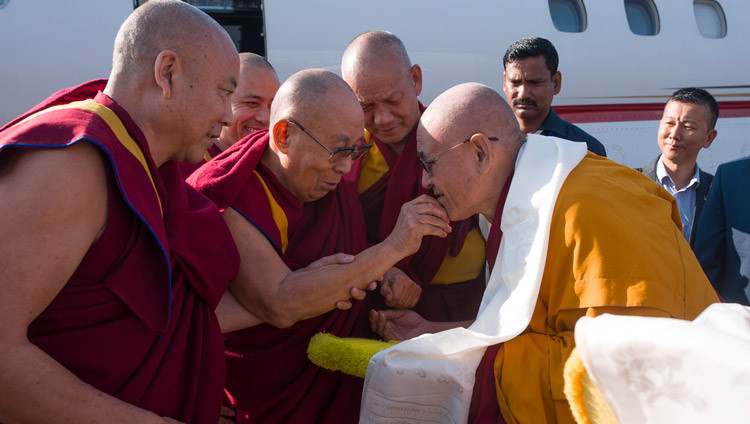
At Hubli airport His Holiness was welcomed by Geshé Jigmé Gyatso, the Abbot of Drepung Gomang Monastery; Mönlam Gyatso, the Senior Administrator; and Jigmé Tsultrim, the Chief Representative of the Central Tibetan Administration in the South. He was also received by Hubli–Dharwad DC Ms. Divya Prabhu, representing the local civil administration, Hubli–Dharwad Police Commissioner, N. Shashikumar, and Hubli–Dharwad DCP Mahaning Nandaganvi. Outside the airport, he was greeted by abbots from various monasteries and Tibetan Settlement Officers from five Tibetan settlements.
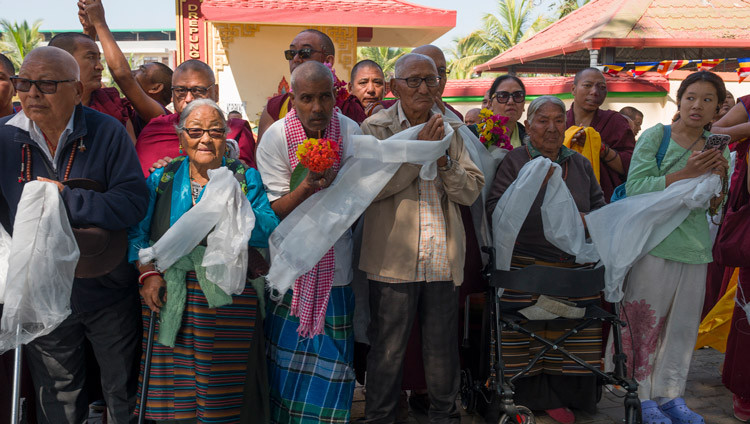
As His Holiness drove towards Mundgod, thousands of people lined the roads to welcome him, including monks and nuns from various monasteries, bearing white scarves, flowers, and incense in their hands. The roads and the settlement were decorated with flags, welcome signs, and spiritual inscriptions.
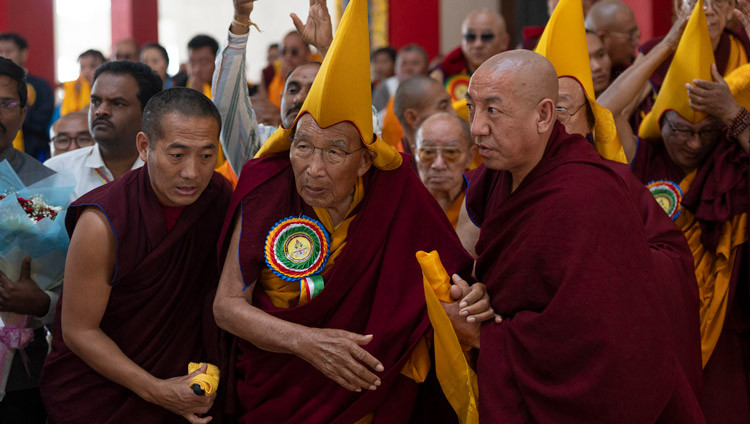
Upon arriving at Drepung Gomang Monastery, His Holiness was received by Most Venerable Lobsang Dorjé, the 105th Ganden Tripa; the Jangtsé Chöjé and the Shartsé Chöjé; the present Drepung Tripa and two former Drepung Tripas; the former and current Abbots of Drepung; as well as abbots and tulkus from various other monasteries and institutions. Also present were Kundeling Rinpoché, Ling Rinpoché, and elderly monks from Buxar, who belonged to the first generation of monks in exile. In addition to these monastic dignitaries, the Dharwad Police Commissioner Gunjan Arya; the Karwar DC Lakshmi Priya; the Karwar SP Deepan M. N.; the Karwar ZP CEO Dr. Dileesh Sasi; the Sirsi AC Kavyarani; the Mundgod Tehsildhar Shankar Gowdi; and the former Chief Justice of the Tibetan Supreme Justice Commission, Tenzin Lungtok, were also there to greet him.
His Holiness walked from the debate ground in front of Drepung Gomang Monastery into the assembly hall, where he took his seat on the throne. The Ganden Tripa, the Drepung Tripa, the Gomang Abbot, and the Tibetan Settlement Officer of Mundgod each offered a mandala and the three-fold representations of the body, speech and mind of the Buddha as the prayer for His Holiness’s long life composed by his two Tutors was chanted.
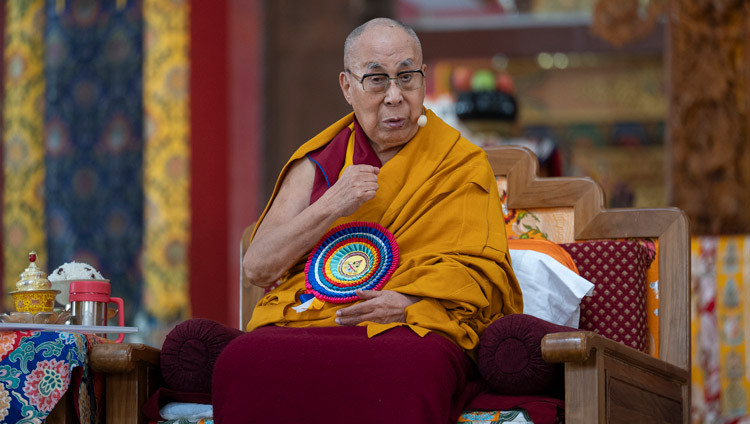
Tea and ceremonial sweet rice were served to the assembly, after which His Holiness briefly addressed the congregation:
“This place where our Tibetan settlements are located lies to the south-west of Tibet. Today, members of the monastic communities have gathered here in a joyful and heartfelt manner. What does this signify? It shows that the vast and profound Buddhist teachings of the sutras and tantras — the immaculate doctrine upheld by great scholars like Nagarjuna — are being preserved by us Tibetans. Despite the difficulties they have faced in Tibet, our people have maintained a strong devotion to their religion and culture.
“The essential point is that we Tibetans feel a deep sense of responsibility for the teachings of the Land of Snows. Today, respect for Tibetan Buddhism is growing, not only among Tibetans, but also in China and around the world. People of different backgrounds are showing increasing appreciation for Tibetan religion and culture.
“We not only pray that the Buddha’s teachings may flourish, we are actively ensuring that the study and realization of the teachings remains alive. Interest in Buddhism is steadily rising, especially among the younger generation. While some people may not show enthusiasm for Buddhism as a religion, there is strong interest in the Buddhist approach to study, contemplation, and inner development. Therefore, we are working to refresh our engagement with the complete teachings of Tibetan Buddhism.
“Buddhism is something people in China, Tibet, and the Himalayan region have long had in common, and this bond continues to deepen. As the Dalai Lama, my explanations of the Dharma have reached many people. The Himalayan region, in particular, has great devotion, and Tibetans have upheld the strong foundations of Buddhist education. Consequently, the teachings — both scriptural and experiential — continue to spread and benefit countless beings.
“I have also held conversations with scientists who are drawn to the practical aspects of Buddhist thought. They are interested not in discussions of past and future lives, but in the methods for cultivating inner peace through a calm and disciplined mind. Even in predominantly Christian countries, this interest is increasing. When I travel abroad, I am warmly welcomed, and people listen with sincerity, leading to a fresh appreciation of Buddhist insights.
“In Tibet, the Dharma was nearly extinguished, but those of us who escaped into exile worked diligently to preserve it. Today, many scientists and others are paying attention to the Buddhist view, meditation, and ethical conduct. Through these exchanges, it is clear that Buddhism offers unique methods for taming the mind and achieving inner peace. The complete teachings of the three vehicles remain intact within our tradition.
“People throughout the Himalayan region show strong interest in the Dharma, especially in the teachings about karma and causality. Because I bear the name of the Dalai Lama, I receive many requests for guidance. Although Chinese authorities have attempted to eliminate the Dharma in Tibet, the profound teachings of Tibetan Buddhism are now gaining even greater attention worldwide.
“While we practitioners continue to uphold these teachings, it is encouraging that scientists and others are taking an interest in them. Thus, the Dharma — rooted in the three higher trainings and focused on cultivating inner peace — is now widely appreciated, even among those who do not necessarily follow any religious practice.”
Following these remarks, and having mentioned prophecies and dreams that indicate that he will live to be more than 130 years old, His Holiness encouraged everyone present to work diligently to revive and strengthen the Dharma and to benefit the world. The Abbot of Gomang Monastery then escorted His Holiness to his quarters on the upper floor of the Debate Courtyard.