Thekchen Chöling, Dharamsala, HP, India - This morning an estimated 4000 people gathered at the Tsuglagkhang, the Main Tibetan Temple to offer prayers for the long life of His Holiness the Dalai Lama. The prayers were requested and supported by former Tibetan political prisoners who now live 15 countries around the world and members of the Lhasa Boys’ Association, a welfare organization begun in Switzerland in the late nineteen sixties.
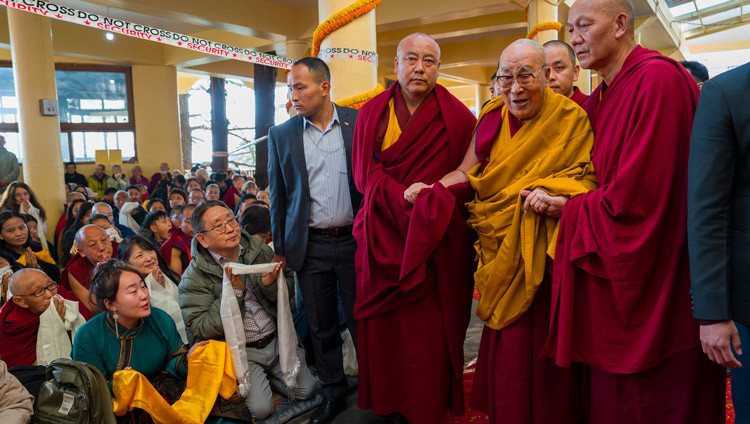
Representatives of these sponsors met His Holiness at the gate to his residence. Then, preceded by monks playing horns and swinging censers, they escorted him to the temple. Smiling broadly, he waved to people on either side of the aisle as he went.
The ceremony was presided over by Kundelling Rinpoché who sat facing His Holiness the Dalai Lama. To Rinpoché’s right sat Geshé Lobsang Samten, the new Abbot of Namgyal Monastery, and to his right was Keutsang Rinpoché. To Kundelling Rinpoché’s left sat Öser Rinpoché, the Dorjé Löbpön of Namgyal Monastery and the Former Disciplinarian of the Monstery.
Today’s prayers focussed on White Tara who bestows long life and is regarded as protecting all sentient beings. She was invoked with a request to “Please come to this place, with your retinue. Now is the time to fulfil your pledge to help sentient beings.” The visualized Tara deity was empowered and an Amitabha Buddha arose on her head. Extensive oceans of offerings were imagined, including water for washing, flowers, music, an ornamental umbrella and victory banner. The Tara mantra was visualized as a wheel.
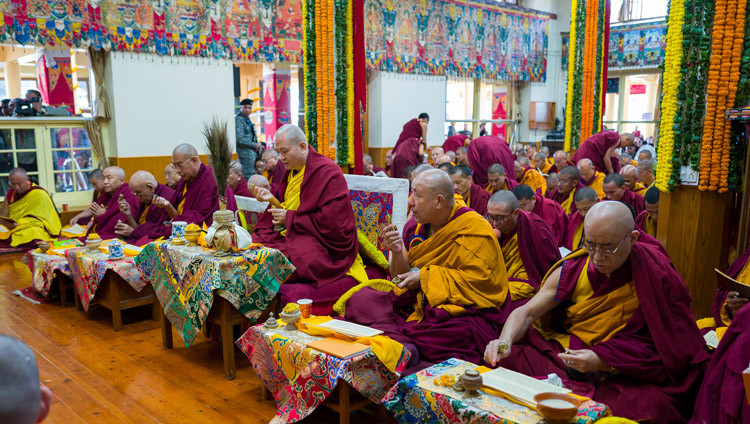
Prayers were made to a series of Lamas and deities, each verse culminating in the following request:
May you prolong the life of our glorious, precious Lama for 100 aeons,
Please grant him the spiritual accomplishment of immortality.
Kundelling Rinpoché approached the throne to present His Holiness with the long-life arrow, which he accepted and flourished. Amitayus, the Buddha of longevity was invoked. His Holiness held at his heart a vajra from which ran a cord that reached each of the Lamas leading the ceremony. The ritual described the Lama’s body being filled with various coloured lights, yellow, red, blue, green and brown, which radiated from the pores of his body to form tents of light. Tara’s mantra was recited envisioned as a wheel.
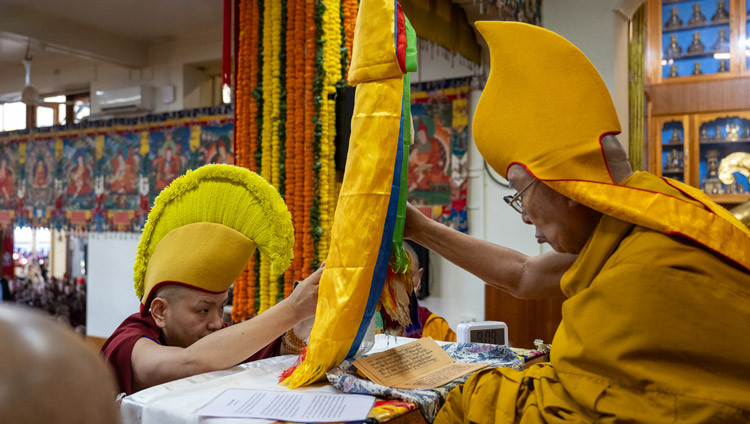
A Tsog (Ganapuja) offering was made from which His Holiness took and ate a portion. The Chant-Master constructed a mandala of grain which Kundelling Rinpoché offered to His Holiness requesting him to live long, following which he presented a statue, scripture and stupa, representations of the body, speech and mind of the Buddha. Next, he offered a vase of longevity, from which His Holiness took a drop, symbols of five Buddha families, nectar of longevity and long-life pills. Subsequently he offered the seven royal emblems, indicating the sovereignty of the Dharma, the eight auspicious symbols, representing the flourishing of virtue, and the eight auspicious substances, which signify overcoming ignorance.
A procession of people bearing offerings such as statues, copies of the Longevity Sutra, monastic robes and so forth, filed through the temple. Individuals approached His Holiness and were given a talisman, a knotted and blessed strip of red cloth. There was a recitation of 'The Melody of the Nectar of Immortality - a Prayer for the Long Life of His Holiness the Fourteenth Dalai Lama, Supreme Victor and Omniscient One by Jamyang Khyentsé Chökyi Lodrö. Bringing up the rear of the procession was a very elderly, white-haired man wearing a white chuba—His Holiness appreciatively patted his head.
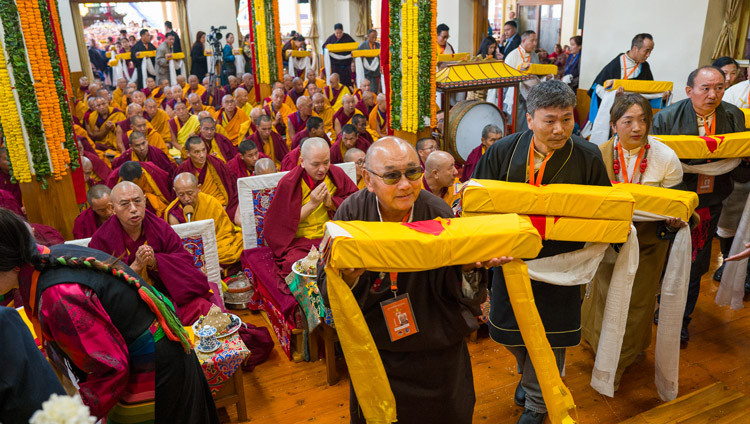
The Chant-master constructed another mandala to be offered to His Holiness as a token of gratitude for his accepting the request that he live for 100 aeons. Representatives of the patrons, women and men, offered representations of the body, speech and mind of the Buddha, recalling that His Holiness Tenzin Gyatso, Avalokiteshvara, is the source of all happiness.
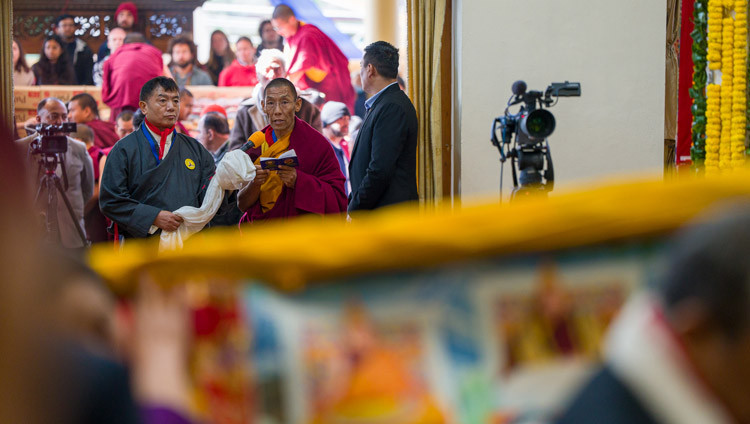
A monk from Namgyal Monastery read out a declaration paying homage to His Holiness and acknowledging his four major commitments. At the same time representatives of the former political prisoners in Tibet presented His Holiness with memento of his having reached his 90th year, along with a painting of him surrounded by people who have been significant in his life — his teachers, Mahatma Gandhi, Jawarhalal Nehru, Mother Teresa, Nelson Mandela and many others. The statement alluded to His Holiness as a teacher of compassion and someone who upholds all traditions of Tibetan Buddhism. There was mention of His Holiness’s guiding prayer:
As long as space endures,
And as long as sentient beings remain,
Until then, may I too remain
To help dispel the misery of the world.
The declaration ended, “We request you to accept this memento and award offered on this occasion by the former political prisoners of Tibet.”
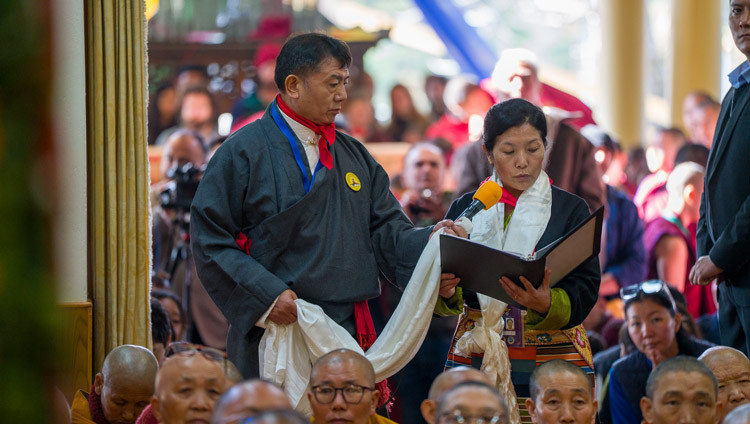
Next, Ngawang Sangdol, one of the ‘Singing Nuns’ who were arrested and punished in Tibet, made her own speech:
“With great hardship Your Holiness left your homeland. Yet, out of compassion you look after all sentient beings, particularly the people of Tibet. You are the sole hope of the entire Tibetan people. The disruptive forces of the Chinese Communist party have brought such adversity to the Tibetan people that they shed tears day and nights as they suffer.
“We are at dire risk of losing our culture and language. People in Tibet have resorted to desperate measures like self-immolation to draw attention to this. We are no longer free in our own land. As a result, we have had to flee our homes. We pray that you, who are the Lord of the Land of Snow, may yet return there.
“The Chinese Communists do not allow Tibetan language to be taught. Teachers continue to teach covertly as best they can, but they do so at great risk to themselves. There are even Chinese officials assigned to teach Tibetan children contrived history. They explain to tourists, for example, that the Potala Palace was built as a gift to a Chinese princess.
“People working for the government are not allowed to visit temples or engage in devout behaviour. All Tibetans are devoted to you, Your Holiness, but children are forced to rebel against their parents. Rules and regulations restrict what Tibetans can do. Children named Tenzin are not allowed to take exams. There is not enough time to describe everything that is going on. Suffice it to say that when we hear your voice, our eyes fill with tears. There is no one else like you who has encouraged combining traditional knowledge with modern science to teach compassion. We pray to be your disciples now and in the future.”
The ceremony was concluded with recitations of the verse for his long life that His Holiness composed at Dilgo Khyentsé Rinpoché’s request, the ‘Prayer for the Ecumenical Flourishing of the Teaching of the Buddha’, the ‘Prayer of the Words of Truth’ and verses from the Samantabhadra Prayer, the King of Prayers.
His Holiness walked from the temple to the lift and then rode in a golfcart through the temple yard smiling and greeting well-wishers on either side.