Shewatsel, Leh, Ladakh, India - This morning prayers were offered for the victims of the recent devastating floods in the Rasuwa region of Nepal and Kyirong in Tibet that have resulted in great loss of life, immense suffering, destruction of homes and infrastructure. His Holiness added to this. “Friends, let us all pray for all those suffering in Nepal and Tibet as a result of this dreadful disaster, both the deceased and the survivors.”
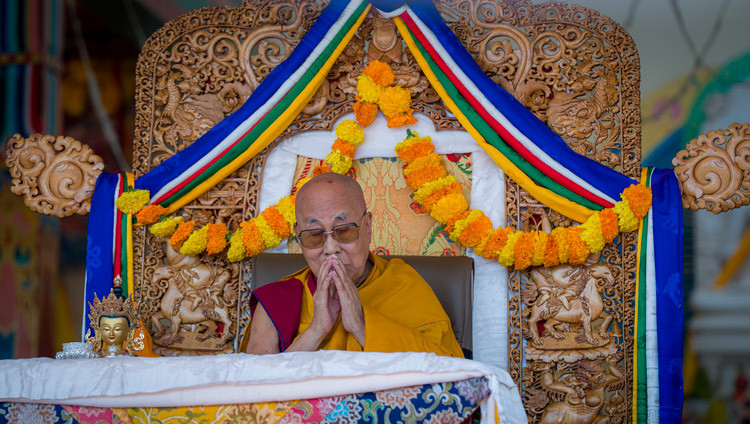
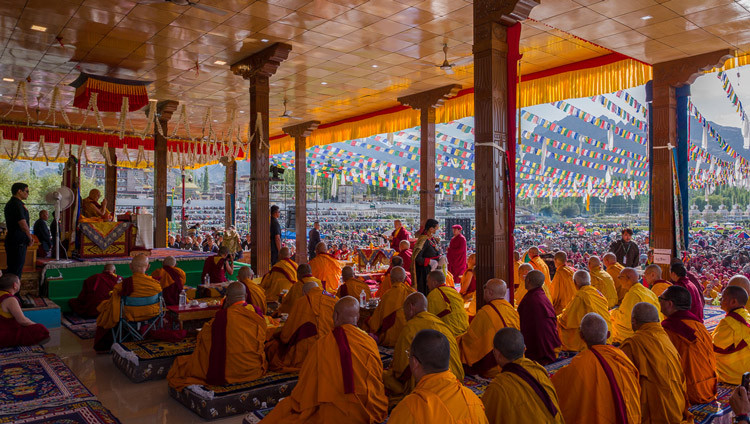
An announcement was made inviting members of the gathering to join in these prayers while also praying for His Holiness the Dalai Lama’s long life in a ceremony organized by the Ladakh Buddhist Association (LBA), the All Ladakh Gonpa Association (ALGA) and the Tibetan Community of Ladakh. The ceremony was held on the Shewatsel Teaching Ground near Choglamsar, Leh, and was attended by an estimated 25,000 people.
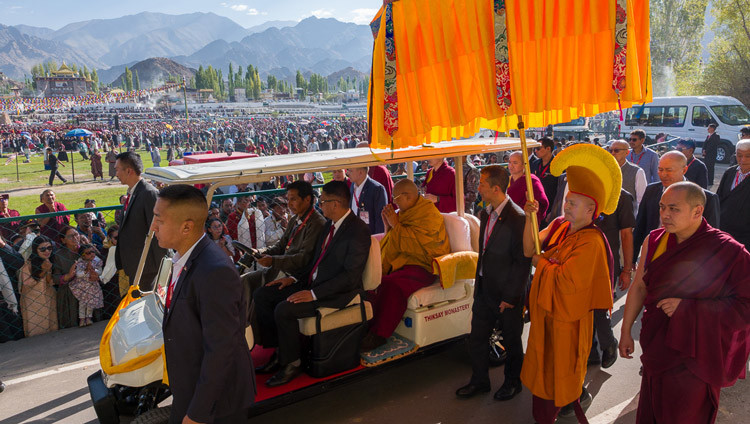
His Holiness drove from his residence at the far end of the ground to the teaching pavilion, smiling and waving as members of the public pressed against the fence to see him as he passed. When he reached the pavilion a group of Ladakhi drummers stood over their drums beating out a warm welcome while groups of laymen and monks blew horns.
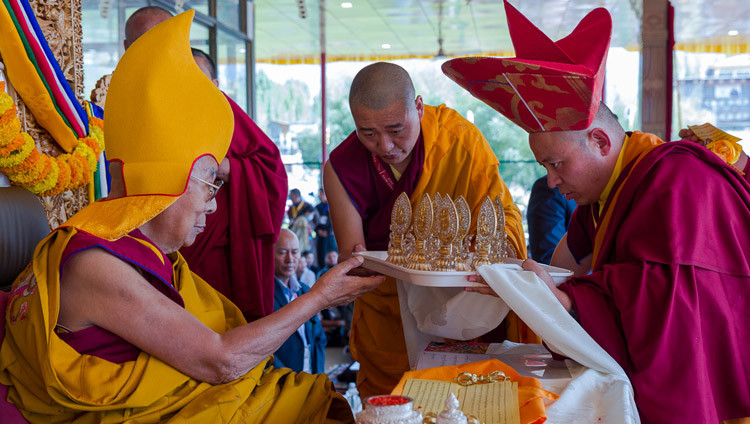
Once His Holiness had taken his seat on the stage, members of the crowd paid their respects by prostrating before him. Prayers began with Drukpa Thuksé Rinpoché presiding. A procession of people belonging to the groups who had organized the ceremony filed past in front of the stage as Rinpoché offered His Holiness a silk scarf. ‘The Seven Limb Prayer’ from the ‘King of Prayers, the Samantabhadra Prayer’, was recited followed by a ‘tsog’ offering from which His Holiness took and ate a portion.
Thuksé Rinpoché offered a mandala that His Holiness accepted and from which he took a pinch of grain that he tossed in the air. Rinpoché then offered representations of the body, speech and mind of the Buddha in the form of a statue, a scripture and a stupa. Next, he presented the two yellow monastic robes, the Namjar and Chögö, a lower robe (shamthab), a pandit’s hat, a mat to sit on (dingwa), an alms bowl filled with fruit, a monastic staff (a kharsil, used to alert householders to a monk’s arrival at their door begging for alms), the seven royal symbols (the precious wheel, the precious elephant, the precious horse, the precious jewel, the precious queen, the precious minister and the precious general), the eight auspicious symbols (an umbrella, a golden fish, a vase, a lotus, a white conch shell, an endless knot, a victory banner and a Dharma Wheel), as well as the eight auspicious substances (a right-coiling conch shell, yogurt, durva grass, vermillion powder, bilva fruit, a mirror, a medicinal substance, and white mustard seed).
The procession of offerings was brought to an end by a solitary, white-haired, white-robed elderly man who betokened longevity. The extensive prayer for His Holiness’s long life composed by his two tutors entitled ‘Song of Immortality’ was recited. Thuksé Rinpoché, other representatives of the organizers and the elderly man came forward to receive His Holiness’s blessings.
His Holiness remarked: “I feel we should also pray for the flourishing of the Buddha’s teaching in Tibet and mainland China, in other words, in places where it has prevailed but has declined, and in places where it has not yet reached. Let us all pray that the tradition of Buddhism that we have preserved will continue to survive and flourish. In Tibet, we maintained a very pure tradition. There are many places where this tradition has attracted interest. I will pray for the continual spread and flourishing of the Buddha’s teaching.
“Growing numbers of people are taking interest in Buddhism these days. People in the Himalayan region, lay-people and monastics, have a single-pointed faith and devotion to the teaching. We have a vast and profound tradition—let us pray it will continue to flourish among the Chinese people as well.
“I am doing my best to be practical about how I go about my practice. You too should do the same, not just paying lip-service to the tradition, but being practical to the best of your ability, about how you put the teachings into effect.”
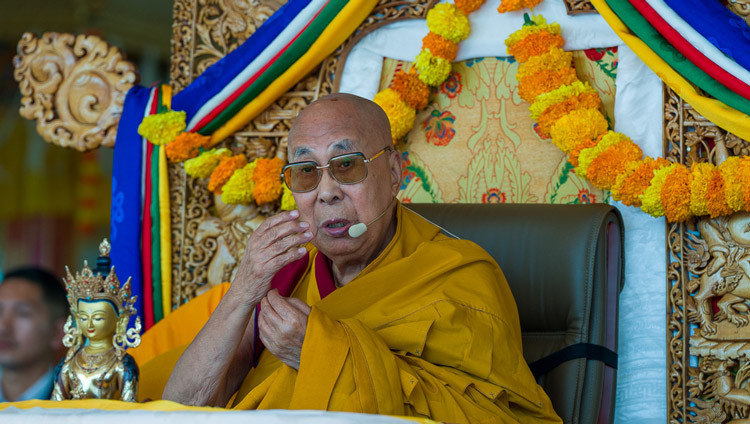
His Holiness then announced that he would give the oral transmission of a number of mantras. He asked members of the congregation to repeat them three times after him as he recited the mantras of the Buddha—Om muni muni maha muniye svaha, of Avalokiteshvara—Om mani padmé hung, of Manjushri—Om ara patsa nadhi, of Arya Tara—Om taré tutaré turé svaha and of Guru Rinpoché—Om ah hung vajra guru padma siddhi hung.
“May whatever merit we have generated here cause us to reach the enlightened state of a Buddha,” His Holiness prayed, “so we may also lead others to that state. The blessing of the Buddha’s teaching is stable among us, let us hope interest in Buddhist philosophy will spread further in India, China, the West and Africa.
“Now, let us pray together, reciting Om mani padmé hung—the mantra of Avalokiteshvara—for those who have died and those who continue to suffer as a result of the terrible floods in Rasuwa in Nepal and Kyirong in Tibet.”
Recitation of the Prayer to the 16 Arhats or Elders resumed. Each verse invoked an Elder and was said three times mentioning what he held in his hands, where he is said to reside as follows—obeisance to Angaja, dwelling on the Great Mount Ti-Se surrounded by 1,300 arhats; Ajita, on Mount Rishi surrounded by 100 arhats; Vanavasin, in the Sapta-Parana cave surrounded by 1,400 arhats; Kalika, on the Island of Tamra-Dvipa surrounded by 1,100 arhats; Vajriputra, in the Land of Sinhaladvipa surrounded by 1,000 arhats; Bhadra, on an Island of the Yamuna surrounded by 1,200 arhats; Kanakavatsa at the holy place of Kashmir surrounded by 500 arhats; Kanakabharadvaja, in Pashchim-Godaniya surrounded by 700 arhats; Bakula, on Uttara-Kuru surrounded by 900 arhats; Rahula, on the Island of Priyangu surrounded by 1,100 arhats; Chudhapanthaka, on Gridha-Kuta-Parvata surrounded by 1,600 arhats; Pindola Bharadvaja, on Videha surrounded by 1,000 arhats; Panthaka, in the Heaven of Thirty-three surrounded by 900 arhats; Nagasena, on Mount Vipula-Parshva surrounded by 1,200 arhats; Gopaka, on Mount Bihula, surrounded by 1,400 arhats; Abheda, on the Great Mount Himvat, surrounded by 1,000 arhats; Upasaka Dharma-Tala and the four guardian kings, Dhritarashtra, Virudhaka, Virupaksha, and Vaishravana, who subdue their retinues and guard the four gates. Each verse concluded with the wish—Please bless the Guru to live long and encourage the doctrine to flourish.
A thanksgiving mandala offering was presented to His Holiness in gratitude for his having agreed to live long by a lay representative of the organizers. The Chief Representative Officer of the Tibetan Community in Ladakh, as well as representatives of the LBA and ALGA offered representations of the body, speech and mind of the Buddha. The Ladakhi translator paid his respects. President of the Ladakh Buddhist Association, Chering Dorjee Lakrook approached to pay his respects and His Holiness gave him a warm hug.
There was a recitation of a ‘Prayer to the Protector Deities of Tibet’ that His Holiness composed in the 60s. This was followed by a ‘Praise to Amitayus: the
Imminent Rising of the Sun’, which concluded:
By the force of the praises and requests made to you,
May all diseases, evil spirits, poverty, and quarrels be calmed,
And may the Dharma and good fortune increase
In the regions in which I and others dwell.
Next came ‘A Prayer for the Flourishing of the Non-Sectarian Teachings of the Buddha’, which included the following verses:
This is the supreme and noble tradition for practising,
Without mistake, the essence and gradual stages of the path,
Which incorporates all three pitakas and all four classes of tantra,
Long may these teachings of the Buddha flourish in the Land of Snows!
May the lives of the masters who uphold these teachings be secure and harmonious!
May the sangha preserve these teachings through their study, meditation and activity!
May the world be filled with faithful individuals intent on following these teachings!
And long may the non-sectarian teachings of the Buddha continue to flourish!
The ceremony was concluded by a recitation of the ‘Prayer of the Words of Truth’ that recalls the pledge of Avalokiteshvara—Chenrezig.
O protector Chenrezig, compassionately care for
Those who have undergone myriad hardships,
Completely sacrificing their most cherished lives, bodies, and wealth,
For the sake of the teachings, practitioners, people, and nation.
Thus, the protector Chenrezig made vast prayers
Before the Buddhas and Bodhisattvas
To fully embrace the Land of Snows;
May the good results of these prayers now quickly appear.
His Holiness walked from his throne to the edge of the platform and waved to members of the audience. He saluted the drummers and horn players gathered at the foot of the steps to see him off. Then he rode in a golf cart from the teaching pavilion back to his residence smiling warmly and waving as he went.